
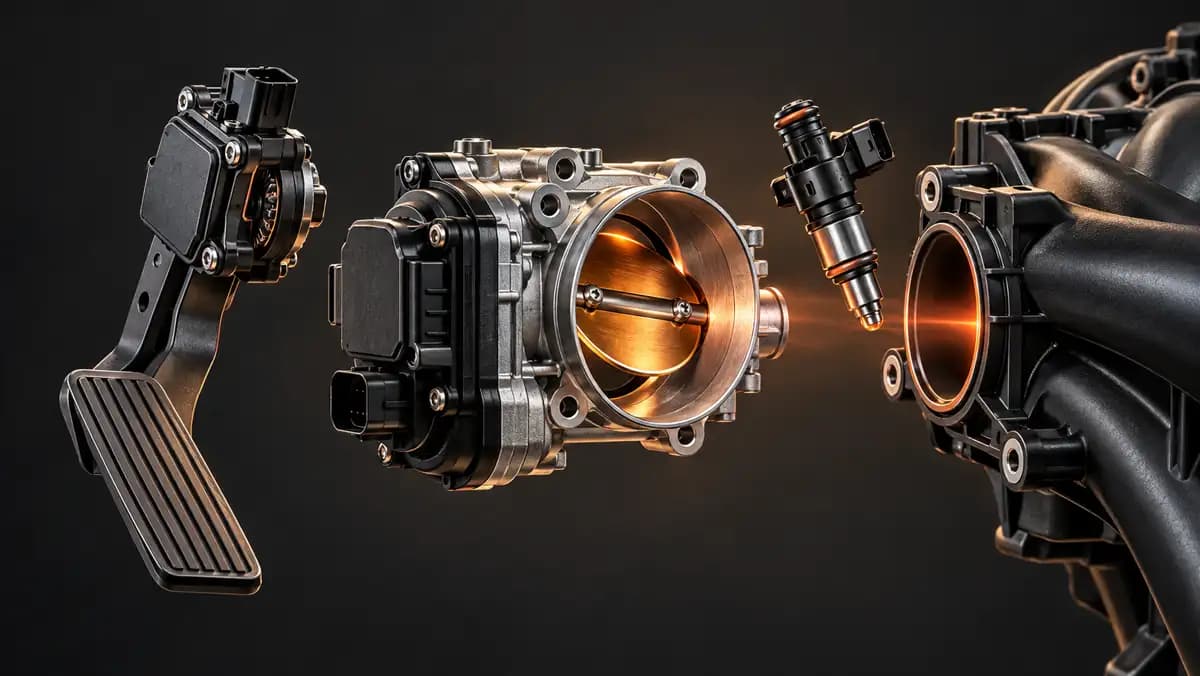
In many modern cars, the accelerator pedal is an electronic input rather than a direct mechanical link to the engine. Pressing it tells the powertrain controller how much torque the driver wants. The controller then coordinates air, fuel, ignition, boost, transmission behavior, emissions controls, and sometimes the electric motor.
The pedal sends a request
Accelerator modules typically use redundant position sensing so the controller can compare signals. If the signals disagree, the system can limit throttle response as a safety strategy.
The requested torque is also compared with other demands. Cruise control, traction control, stability control, transmission protection, engine-temperature limits, and driver modes can all change the final command.
Airflow is controlled precisely
On a gasoline engine, an electric motor moves the throttle plate to change the intake opening. The controller monitors the plate position and measures or estimates the air entering the engine. Fuel delivery is then calculated to match the airflow and operating condition.
During a cold start, hard acceleration, deceleration, or catalyst warm-up, the target mixture and ignition timing may differ from steady cruising. Turbocharged engines add another layer by controlling boost pressure and wastegate or variable-geometry operation.
Why throttle faults feel confusing
Poor response does not automatically mean the throttle body is dirty. Similar symptoms can come from:
- A pedal-position or throttle-position signal problem.
- Unmetered air entering through a leak.
- Low fuel pressure or restricted injectors.
- Ignition misfire under load.
- Transmission torque management.
- A protection mode triggered by an unrelated fault.
Live data helps separate the driver's request from the engine's response. Compare accelerator position, commanded throttle, actual throttle angle, airflow, fuel trims, engine load, boost where applicable, and vehicle speed.
A system designed around torque
The accelerator is best understood as one participant in a coordinated control system. That explains why the engine can close the throttle during a gear change, reduce torque when a wheel slips, or respond differently in Eco and Sport modes even though the driver's foot moves the same distance.
Sources and further reading
General educational guide
For information, not a diagnosis or repair instruction. Vehicle-specific checks are still required. Consult the manufacturer's guidance and a qualified technician.
How to use this information
This article explains general principles and does not establish what is wrong with your vehicle. Illustrations are conceptual. Read the content limitations.
Content and reuse
An AI-assisted educational explanation prepared for AI4Car. References provide factual context; linking to a publication does not grant a license to its text or images or imply its author’s endorsement. No Creative Commons license is asserted for those third-party materials.
Illustration: AI-generated for AI4Car; a generic conceptual view, not a photograph of the reported vehicle or a manufacturer’s diagram. Content and licensing policy.
Was this useful?
Discussion
Share what you checked, what changed, and which vehicle you drive. Up to 10 comments and replies per account in 24 hours.
Loading discussion…