
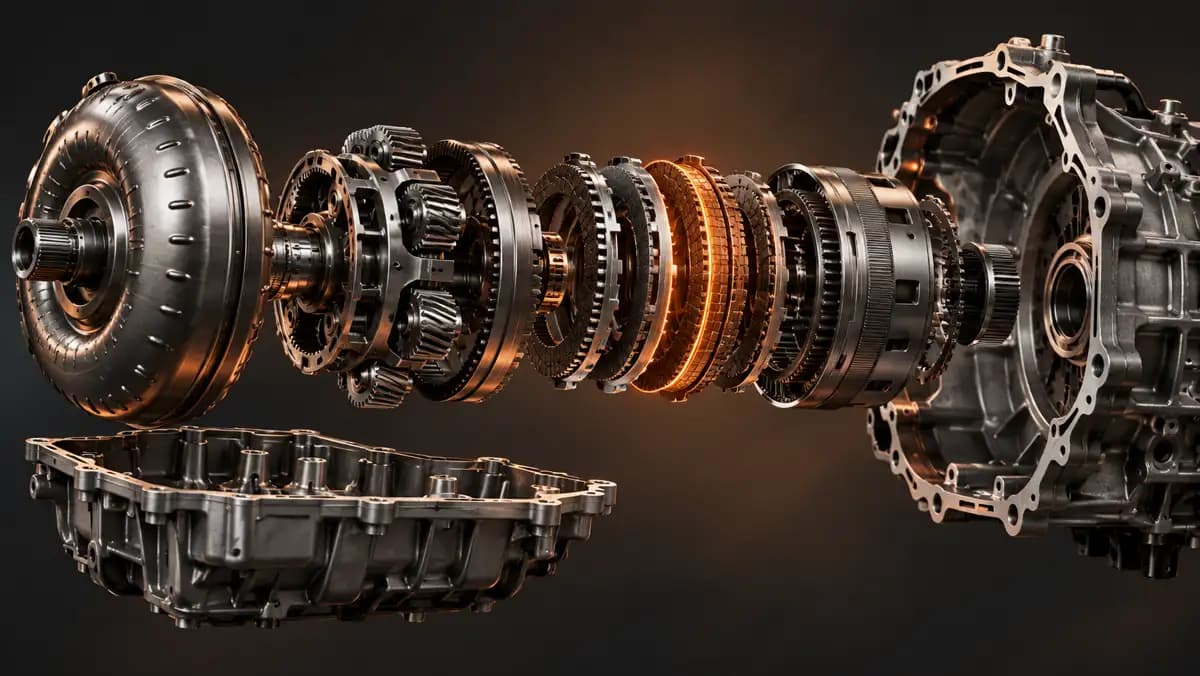
An automatic transmission does not follow one fixed speed chart. Its controller continuously chooses a ratio based on what the driver is asking for, what the engine can deliver, and what the transmission can safely handle.
The controller is balancing several goals
At light throttle, an early upshift can reduce engine speed and fuel consumption. During stronger acceleration, holding a lower gear keeps the engine in a more useful power range. On a descent, the transmission may downshift to provide engine braking. When the fluid is cold or hot, the strategy may change again.
Common inputs include accelerator position, engine torque, vehicle and shaft speeds, brake-pedal status, steering or stability-system requests, transmission-fluid temperature, and sometimes road gradient.
The hardware depends on transmission type
A conventional automatic combines a torque converter with planetary gearsets and hydraulically applied clutch packs. A dual-clutch transmission uses two clutch paths for alternating gears. A continuously variable transmission changes its ratio without traditional fixed gear steps. Each can feel different while pursuing the same basic goal: place the engine and driveline in an appropriate operating range.
Why a shift can feel wrong
A harsh, delayed, slipping, or repeated shift does not identify one failed part. The cause can involve:
- Incorrect or degraded fluid, or an incorrect fluid level.
- A speed, temperature, pressure, or throttle-related sensor signal.
- Hydraulic pressure loss or a sticking control valve.
- Worn clutch material or mechanical damage.
- Engine torque irregularity that is felt through the transmission.
- Adaptation values that no longer match actual hardware behavior.
Context makes scan data useful
Record when the symptom occurs: cold or hot, light or heavy throttle, uphill or level, during an upshift, downshift, or converter-clutch event. Compare commanded gear with actual ratio, input and output speeds, fluid temperature, brake status, and available pressure data.
Avoid clearing adaptations or installing software simply to see what happens. Those actions can erase useful evidence and may require a specified relearn procedure. A transmission is a mechanical, hydraulic, and electronic system; diagnosis should consider all three layers before parts are replaced.
General educational guide
For information, not a diagnosis or repair instruction. Vehicle-specific checks are still required. Consult the manufacturer's guidance and a qualified technician.
How to use this information
This article explains general principles and does not establish what is wrong with your vehicle. Illustrations are conceptual. Read the content limitations.
Content and reuse
An AI-assisted educational explanation prepared for AI4Car. References provide factual context; linking to a publication does not grant a license to its text or images or imply its author’s endorsement. No Creative Commons license is asserted for those third-party materials.
Illustration: AI-generated for AI4Car; a generic conceptual view, not a photograph of the reported vehicle or a manufacturer’s diagram. Content and licensing policy.
Was this useful?
Discussion
Share what you checked, what changed, and which vehicle you drive. Up to 10 comments and replies per account in 24 hours.
Loading discussion…