
The owner's question
A 1957 Chevrolet owner reported that the battery voltage fell sharply a few hours after engine work. They wondered whether the starter solenoid could be responsible. The replies proposed different explanations, including unwanted electrical draw and a battery fault; no final measured cause was posted.
Two different problems can look alike
An electrical circuit may continue consuming power with the car parked. A weak battery can also lose useful voltage even when the vehicle has little parked draw. Replacing a starter or alternator without measuring either condition may miss the problem.
A useful workshop request
- Ask for a battery state-of-health or load test and record the result.
- Measure the parked current draw using a method appropriate to the vehicle. Modern cars may need time to go to sleep; disturbing a circuit can wake modules and spoil the reading.
- If excessive draw is verified, isolate the circuit safely, then inspect components and connections touched during the recent work.
- Have charging voltage checked under the vehicle's specified conditions.
The takeaway
A clear symptom and a recent repair are clues, not proof that the last mechanic or the starter caused the drain. A couple of measurements turn a vague complaint into a targeted diagnostic job.
Community discussion · outcome not verified
For information, not a diagnosis or repair instruction. A reported result may not apply to your car. Consult the manufacturer's guidance and a qualified technician.
How to use this information
This is an editorial interpretation of a public discussion. Replies, votes and an accepted answer do not prove a diagnosis. An author-reported finding or repair has not been independently verified by AI4Car. Illustrations are conceptual. Read the content limitations.
Credits & reuse
AI-assisted adaptation by AI4Car of the contributions below on Motor Vehicle Maintenance & Repair Stack Exchange. We shortened and reorganized the discussion, paraphrased its text and added educational context. These are reported experiences, not independently verified repairs. The contributors do not endorse AI4Car.
- Question: High parasitic drawBy SRQDean · CC BY-SA 4.0
- Answer: High parasitic drawBy fraxinus · CC BY-SA 4.0
- Answer: High parasitic drawBy GdD · CC BY-SA 4.0
This adapted article text, including AI4Car’s additions, is available under CC BY-SA 4.0. Reuse is permitted under that license with attribution, an indication of changes and ShareAlike. This notice excludes the separate illustration, site design and user comments. The source revision history remains available at Stack Exchange.
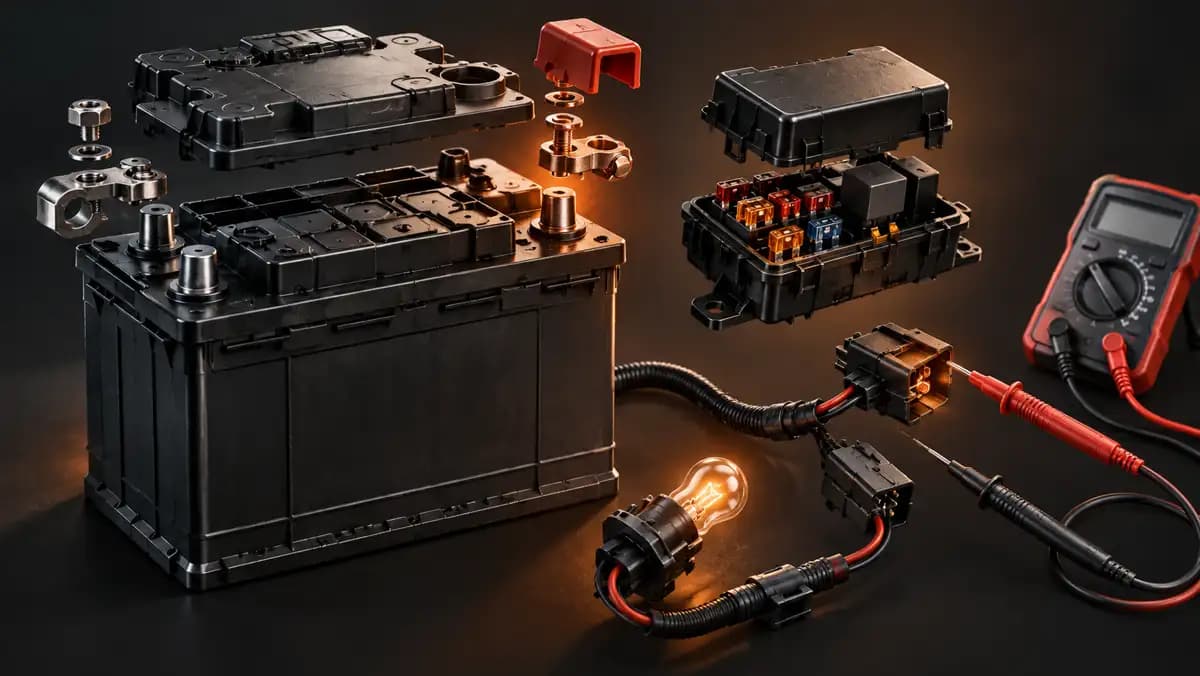
Illustration: AI-generated for AI4Car; a generic conceptual view, not a photograph of the reported vehicle or a manufacturer’s diagram. Content and licensing policy.
Was this useful?
Discussion
Share what you checked, what changed, and which vehicle you drive. Up to 10 comments and replies per account in 24 hours.
Loading discussion…