
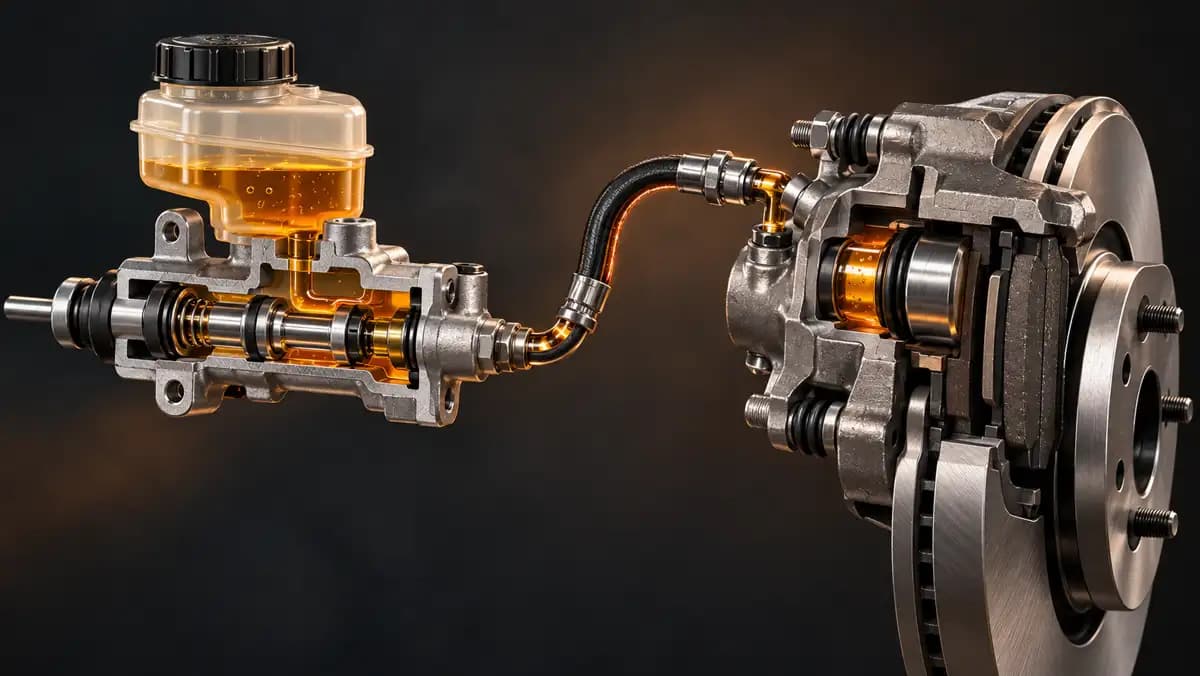
When you press the brake pedal, you are not mechanically pushing each brake pad against a disc. The master cylinder converts pedal force into hydraulic pressure, and brake fluid carries that pressure through lines and hoses to the brakes at each wheel.
Why the fluid has a difficult job
Brake fluid must remain predictable in winter, resist boiling near hot brakes, protect metal components, and remain compatible with seals and hoses. Different DOT specifications have different performance requirements and are not interchangeable in every system.
Most glycol-based brake fluids gradually absorb moisture through hoses, seals, and normal service exposure. That can lower the fluid's boiling performance and contribute to internal corrosion. The fluid may still look acceptable in the reservoir while its properties have changed.
What happens when fluid gets too hot
Hard braking converts vehicle speed into heat. If the fluid reaches its boiling point, vapor can form. Liquid transfers pressure effectively; vapor compresses. The result can be a pedal that becomes soft or travels farther when the brakes are hottest.
This is different from normal pad wear, air introduced during service, or a hydraulic leak, but the symptoms can overlap. A braking problem should be diagnosed rather than guessed from fluid color alone.
Fluid level is also information
A small level change may occur as brake pads wear and caliper pistons move outward. A rapid or substantial drop can indicate a leak and needs immediate investigation. Simply topping up the reservoir can hide a useful clue.
Sensible brake-fluid service
- Use only the specification approved for the vehicle.
- Keep new fluid sealed; an opened container can absorb moisture.
- Follow the manufacturer's replacement interval where one is specified.
- Do not mix silicone DOT 5 fluid into a system designed for glycol-based fluid.
- If the pedal changes suddenly, inspect the braking system before driving farther.
Brake fluid is easy to ignore because it has no visible tread and rarely makes noise. Its condition matters precisely because hydraulic braking depends on the fluid behaving consistently when the system becomes hot and heavily loaded.
Sources and further reading
General educational guide
For information, not a diagnosis or repair instruction. Vehicle-specific checks are still required. Consult the manufacturer's guidance and a qualified technician.
How to use this information
This article explains general principles and does not establish what is wrong with your vehicle. Illustrations are conceptual. Read the content limitations.
Content and reuse
An AI-assisted educational explanation prepared for AI4Car. References provide factual context; linking to a publication does not grant a license to its text or images or imply its author’s endorsement. No Creative Commons license is asserted for those third-party materials.
Illustration: AI-generated for AI4Car; a generic conceptual view, not a photograph of the reported vehicle or a manufacturer’s diagram. Content and licensing policy.
Was this useful?
Discussion
Share what you checked, what changed, and which vehicle you drive. Up to 10 comments and replies per account in 24 hours.
Loading discussion…