
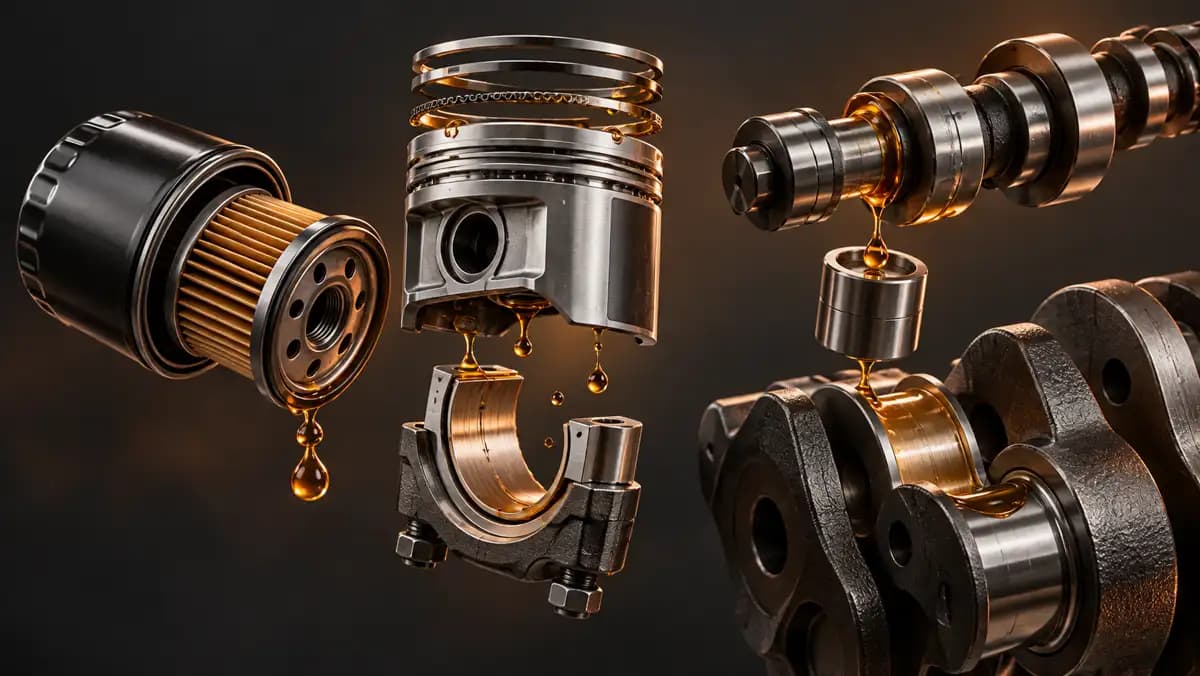
Engine oil is often described as a lubricant, but that single word hides several jobs. Inside a running engine, oil must protect heavily loaded surfaces, move heat, control deposits, support hydraulic mechanisms, and remain pumpable across a wide temperature range.
It creates a controlled film
Crankshaft bearings, camshafts, turbocharger bearings, and other components depend on a thin oil film that keeps metal surfaces apart. The film is not equally thick everywhere. Speed, load, clearance, oil pressure, temperature, and viscosity all affect it.
This is why “thicker is safer” is not a useful general rule. Oil that is too viscous for the engine and climate may circulate slowly during a cold start. Oil that is too thin for the design may not maintain the intended film under load. The correct grade and specification come from the vehicle manufacturer.
Oil also cleans and carries heat
Detergent and dispersant additives help keep small contaminants suspended until the filter captures them or the oil is drained. Oil also removes heat from pistons, bearings, turbochargers, and other areas that coolant cannot reach directly.
As oil ages, additives are consumed and contamination accumulates. Fuel dilution, soot, moisture, and repeated heat cycles can all change how the oil behaves. Color alone is not a reliable test: some oils darken quickly because they are holding contamination as intended.
Pressure is not the same as oil level
The dipstick or electronic level sensor tells you how much oil is available. The oil-pressure warning tells you whether the lubrication system is building enough pressure. A pressure warning while the engine is running requires immediate attention; adding oil without checking the cause is not always sufficient.
A useful maintenance approach
- Use the viscosity and performance specification in the owner's manual.
- Follow the normal or severe-service interval that matches actual use.
- Check the level regularly and before long journeys.
- Investigate a falling level, visible leaks, burning smell, or blue exhaust smoke.
- Replace the filter with the oil unless the manufacturer specifies otherwise.
The best oil is not the most expensive bottle on the shelf. It is an oil that meets the required specification, stays in the engine at the correct level, and is replaced on an interval appropriate for how the car is really driven.
Sources and further reading
General educational guide
For information, not a diagnosis or repair instruction. Vehicle-specific checks are still required. Consult the manufacturer's guidance and a qualified technician.
How to use this information
This article explains general principles and does not establish what is wrong with your vehicle. Illustrations are conceptual. Read the content limitations.
Content and reuse
An AI-assisted educational explanation prepared for AI4Car. References provide factual context; linking to a publication does not grant a license to its text or images or imply its author’s endorsement. No Creative Commons license is asserted for those third-party materials.
Illustration: AI-generated for AI4Car; a generic conceptual view, not a photograph of the reported vehicle or a manufacturer’s diagram. Content and licensing policy.
Was this useful?
Discussion
Share what you checked, what changed, and which vehicle you drive. Up to 10 comments and replies per account in 24 hours.
Loading discussion…