
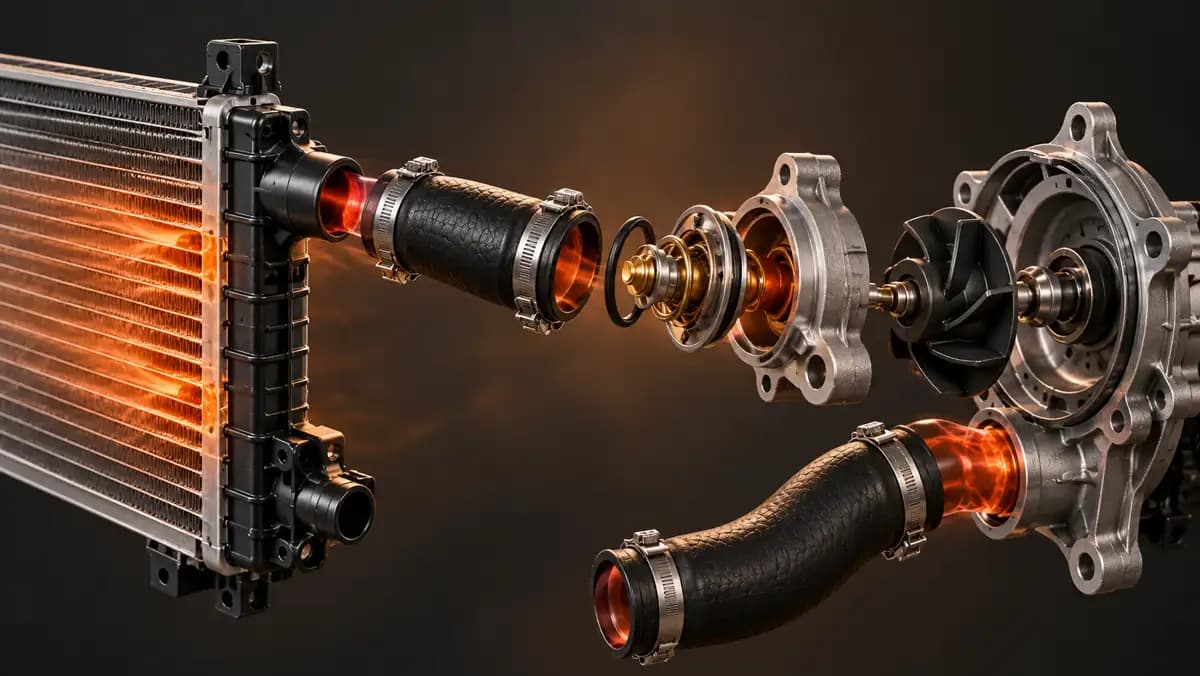
A running engine turns fuel into motion, but a large share of the fuel's energy becomes heat. The cooling system has to move that heat away quickly enough to protect the engine, while also keeping the engine warm enough to run efficiently. It is a balancing system, not simply a device that makes the engine cold.
The coolant circuit
Coolant travels through passages in the engine block and cylinder head, absorbing heat around the combustion chambers. A pump keeps it moving. Once the coolant reaches the radiator, heat passes through thin tubes and fins into the air flowing through the front of the car.
At road speed, natural airflow does much of the work. In slow traffic, electric fans pull air through the radiator. Modern vehicles may vary pump and fan speed instead of running everything at full output all the time.
Why the thermostat matters
When the engine is cold, the thermostat restricts flow to the radiator. This helps the engine reach its intended operating temperature sooner. As temperature rises, the thermostat opens and allows more coolant through the radiator.
A thermostat stuck open can make warm-up unusually slow and reduce heater performance. One stuck closed can cause rapid overheating. Temperature data that climbs steadily and then stabilizes is very different from data that swings, spikes, or never reaches the expected range.
The heater is part of the same system
The cabin heater uses a smaller heat exchanger called the heater core. Hot coolant passes through it, and the blower moves air across it. Weak cabin heat can therefore be a useful clue: low coolant, trapped air, poor circulation, or a thermostat problem may affect both engine temperature and interior heating.
What drivers can observe
- A sweet smell or colored residue can indicate a coolant leak.
- A fan that runs constantly may reflect high temperature, an electrical problem, or a fail-safe strategy.
- Temperature that rises mainly at idle can point toward airflow or fan trouble.
- Temperature that rises under load can suggest insufficient coolant flow, restricted heat transfer, or combustion gases entering the system.
Never remove a pressurized cooling-system cap while the engine is hot. If the temperature warning appears or steam is visible, stop safely and follow the vehicle manufacturer's instructions. The useful diagnostic question is not just “Is it hot?” but “When does it become hot, and what is the coolant circuit doing at that moment?”
Sources and further reading
General educational guide
For information, not a diagnosis or repair instruction. Vehicle-specific checks are still required. Consult the manufacturer's guidance and a qualified technician.
How to use this information
This article explains general principles and does not establish what is wrong with your vehicle. Illustrations are conceptual. Read the content limitations.
Content and reuse
An AI-assisted educational explanation prepared for AI4Car. References provide factual context; linking to a publication does not grant a license to its text or images or imply its author’s endorsement. No Creative Commons license is asserted for those third-party materials.
Illustration: AI-generated for AI4Car; a generic conceptual view, not a photograph of the reported vehicle or a manufacturer’s diagram. Content and licensing policy.
Was this useful?
Discussion
Share what you checked, what changed, and which vehicle you drive. Up to 10 comments and replies per account in 24 hours.
Loading discussion…