
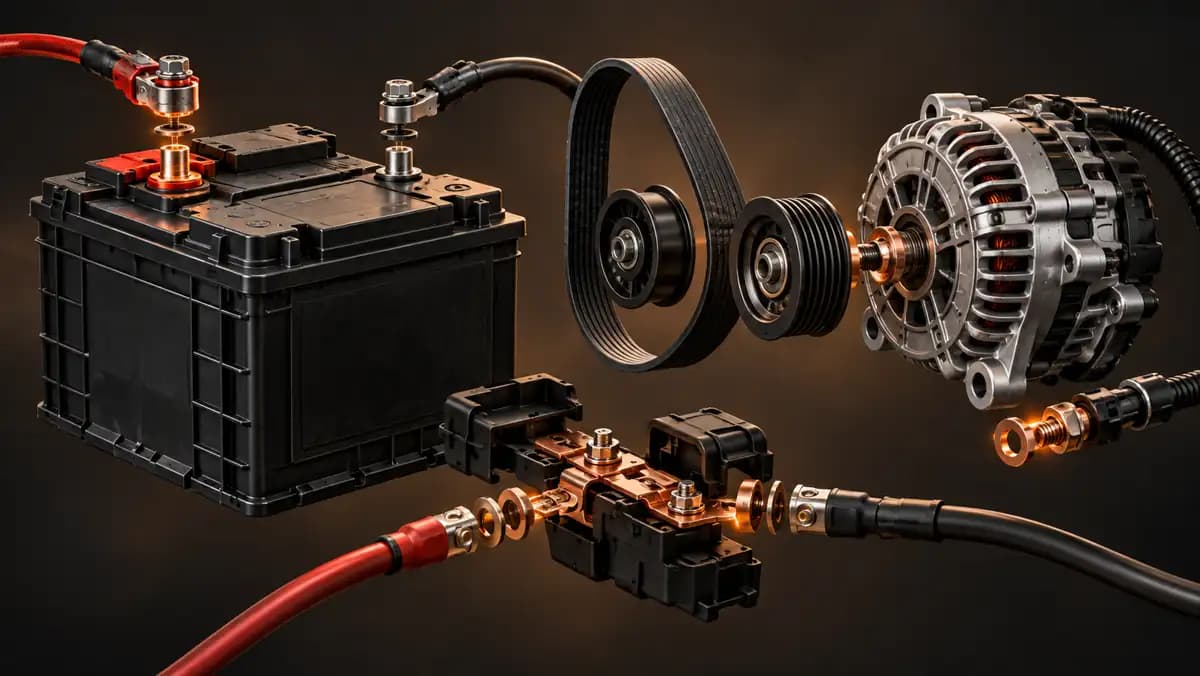
The battery and alternator work together, so a fault in one can make the other look guilty. The battery stores electrical energy. It supplies the starter and supports the vehicle when demand exceeds charging output. Once the engine is running, the alternator converts mechanical rotation into electrical energy and recharges the battery.
What happens during starting
The starter draws a large current for a short time. A battery can show a reasonable open-circuit voltage and still collapse under that load. That is why a proper test considers voltage, available starting current, temperature, and battery condition rather than relying on one reading.
Slow cranking, repeated clicking, or electronics resetting during a start can point toward a weak battery, poor terminal connection, damaged ground cable, or starter problem.
What happens after the engine starts
The charging system must power lights, control units, pumps, fans, heaters, and entertainment equipment while restoring energy used during starting. Modern vehicles may deliberately vary alternator output to reduce load or recover energy during deceleration. A fixed “healthy voltage” rule therefore does not describe every operating strategy.
Battery-monitoring sensors can measure current, voltage, and temperature so the vehicle can estimate state of charge and battery health. Some cars also require a replacement battery to be registered in the energy-management system.
Patterns that help separate the faults
- The engine starts after charging but is weak again after sitting: test the battery and check for an excessive key-off draw.
- The battery warning appears while driving: inspect charging output, belt drive, wiring, and control before assuming the battery itself is bad.
- Lights brighten and dim with engine speed: check regulation and electrical connections.
- A new battery repeatedly becomes discharged: find the reason rather than replacing it again.
Test the system, not only the parts
A useful diagnosis includes battery state of charge, a load or conductance test, charging behavior under different electrical loads, voltage drop across positive and ground cables, and a parasitic-draw test when needed.
Replacing the battery may temporarily mask a charging or standby-current problem. Replacing the alternator may leave a weak battery unable to accept and store the charge. The components are partners, and the test should treat them that way.
Sources and further reading
General educational guide
For information, not a diagnosis or repair instruction. Vehicle-specific checks are still required. Consult the manufacturer's guidance and a qualified technician.
How to use this information
This article explains general principles and does not establish what is wrong with your vehicle. Illustrations are conceptual. Read the content limitations.
Content and reuse
An AI-assisted educational explanation prepared for AI4Car. References provide factual context; linking to a publication does not grant a license to its text or images or imply its author’s endorsement. No Creative Commons license is asserted for those third-party materials.
Illustration: AI-generated for AI4Car; a generic conceptual view, not a photograph of the reported vehicle or a manufacturer’s diagram. Content and licensing policy.
Was this useful?
Discussion
Share what you checked, what changed, and which vehicle you drive. Up to 10 comments and replies per account in 24 hours.
Loading discussion…